Great Indian Peninsula Railway
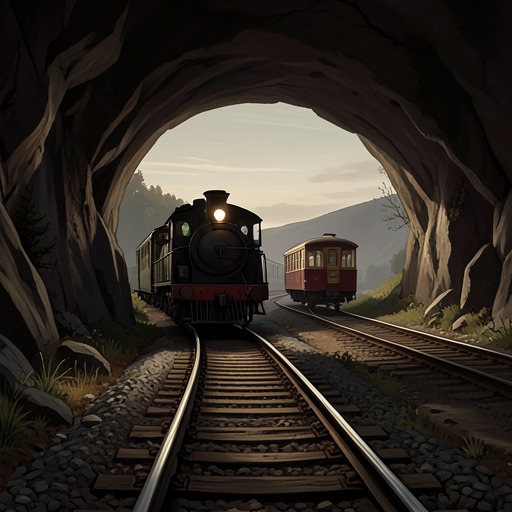
Around the World in Eighty DaysThe Great Indian Peninsula Railway is presented as a transformative route across India and as a practical condition of the novel’s accelerated global journey. Its speed makes an eighty-day circumnavigation seem possible, but the line’s unfinished section at Kholby turns that promise into a problem of actual access: a railway can compress distance only where its tracks reach.
Development and Reach
The railway belongs to a changing transport landscape. Earlier travel across India depended on foot, horseback, palanquins, or cumbersome coaches; by contrast, steamboats served the Indus and Ganges, while a railway with branch lines joining its main route traversed the peninsula from Bombay to Calcutta in three days. The account places this development within a broader political transformation: after the East India Company’s period of expansion and rule, British possessions in India had come under the direct control of the Crown, while the country’s appearance and social distinctions were changing.
The railway did not follow the shortest line between its endpoints. Although Bombay and Calcutta were only about one thousand to eleven hundred miles apart as the crow flies, the track’s deviations added more than a third to that distance. Its practical achievement was therefore not a straight crossing but a connected route that made a long journey possible on a tightly compressed timetable.
Route Across India
From Bombay, the line passed through Salcette and crossed to the continent opposite Tannah. It then climbed over the Western Ghauts and ran northeast toward Burhampoor, skirting the nearly independent territory of Bundelcund before ascending to Allahabad. From there it turned east toward the Ganges at Benares, left the river again, and descended southeast by Burdivan and the French town of Chandernagor to its terminus at Calcutta.
That sequence of turns makes the railway’s reach concrete: it linked ports, inland towns, river crossings, and territories rather than simply drawing a line between two major cities. The route also explains why the distance traveled by rail exceeded the direct geographical distance. Its network offered rapid movement, but only along a particular, indirect corridor.
The Eighty-Day Timetable
The railway enters the wager’s calculation as evidence that the world’s journeys had become markedly faster. In a discussion at the Reform Club, Ralph argues that a person could travel around the world ten times more quickly than a century earlier, connecting that acceleration both to the greater chance of catching a thief and to the thief’s greater ability to escape. John Sullivan then cites the opening of the Rothal-to-Allahabad section of the Great Indian Peninsula Railway as part of the basis for an eighty-day itinerary. Phileas Fogg insists on that precise duration when another speaker refers to three months.
The travel schedule becomes immediate when passengers from the Mongolia land at half-past four in the afternoon and the train is due to depart for Calcutta at eight. After leaving the steamer and giving Passepartout errands, Fogg goes to the passport office and then to the station. The railway is thus not merely a statistic in an abstract calculation: its departure time governs the next stage of a journey in which minutes matter.
The Unfinished Section at Kholby
The timetable’s apparent certainty is unsettled at Kholby. When asked whether the train stops there, a railway employee explains that the railway is not finished: fifty miles remain to be laid between Kholby and Allahabad, where the line begins again. The revelation directly contradicts the passengers’ understanding that newspapers had announced the railway’s opening throughout.
This interruption exposes the difference between a network described as complete and one that can actually carry travelers end to end. The railway has made rapid travel across India imaginable, but its missing link leaves passengers to confront the distance outside the rails. In the novel, modern speed is therefore real but conditional: it depends on completed track, accurate information, and the availability of a way to cross whatever the network has not yet connected.